When Beauty Filters Escalate to AI Porn Generators
17.09.2026
The Escalation from Aesthetic Filters to Explicit Generation
A teenager adjusting the jawline width on a selfie is engaging in the same fundamental process as an AI model synthesising explicit imagery: altering reality to satisfy an external standard or an internal curiosity. The transition from standard photo editors to AI porn generators https://slygen.ai/features/generation/hentai is rarely abrupt. It follows a continuum of modification where the threshold for what constitutes acceptable alteration gradually shifts. A skin-smoothing filter leads to a blemish remover, which leads to a body-reshaping slider, which eventually leads to an AI tool capable of undressing a subject or generating explicit scenes from text prompts. Recognising this escalation is the first step in mitigating the specific dangers these tools pose to adolescents, as the friction between a benign edit and harmful generation is often dangerously low.
Psychological and Social Symptoms
The symptoms of this technological escalation manifest in both psychological distress and social harm. The most immediate symptom is body dysmorphia exacerbated by constant filtered viewing—a condition now sufficiently prevalent that dermatologists and psychologists report teens seeking cosmetic procedures to resemble their digital avatars. As teenagers seek more drastic modifications to match unrealistic standards, they gravitate toward AI-driven editors that offer radical transformations.
The symptom that demands urgent attention, however, is the generation or distribution of non-consensual explicit imagery. When teenagers use AI porn generators on their own or their peers' images, the social fallout is severe. Victims experience profound psychological harm, often indistinguishable from the trauma of traditional non-consensual imagery sharing. For the creator, the act desensitises them to the humanity of their peers, categorising individuals as mere inputs for algorithmic manipulation. The social environment degrades as trust erodes, replaced by an implicit understanding that any photograph might be weaponised.
Identifying the Underlying Causes
Understanding the causes requires examining the environment that surrounds image modification. The first cause is the normalisation of digital distortion. When a skin-smoothing filter is positioned as a standard prerequisite for social interaction, an AI body editor appears as898 as merely a logical upgrade rather than a qualitative leap into deception. The commercial architecture of these applications reinforces this; developers design sliders and prompts to be frictionless, encouraging deeper engagement without pausing to contextualise the ethical weight of the modification.
The second cause is accessibility. App stores and social platforms frequently place advanced generative AI tools alongside benign editors, often without robust age gates. Many AI porn generators operate via web interfaces that require no identity verification, relying on open-source models that have been repurposed for explicitE explicit generation. The third cause is peer dynamics. The demand for novel, provocative content in closed social groups drives experimentation. In environments where shock value commands attention, the ability to generate explicit imagery from a clothed photograph becomes a social currency.
Verifying the Threat: Evidence versus Conjecture
Distinguishing evidence from conjecture is vital when assessing2 when assessing these risks. Evidence confirms a rising incidence of AI-generated nude images in secondary schools, frequently created using tools marketed as "cloth-removal" editors. Law enforcement and child protection agencies have documented specific cases of sextortion and bullying facilitated by these generators. Furthermore, research into adolescent online behaviour demonstrates a direct correlation between exposure to idealised imagery and declining self-esteem.
Conjecture, however, surrounds the assumption that using a beauty filter directly and inevitably causes a teenager to seek out an AI porn generator. The relationship is correlational and contextual. A teenager with high digital literacy and strong self-esteem might use aesthetic filters casually without ever escalating to explicit generation. The risk concentrates where low self-esteem, intense social?&x intense social pressure, and unfiltered access to generative models intersect. It is also conjectural to assume that technical blocks alone can extinguish curiosity; forbidden tools often hold heightened appeal for adolescents navigating boundary-testing developmental phases.
Comparing Mitigation Strategies
Addressing these risks demands a comparison of available mitigation strategies. Solutions range from technical restrictions to educational interventions, each carrying specific trade-offs. Evaluating these strategies requires fair selection criteria: efficacy in preventing harm, scalability across diverse platforms, and the privacy impact on the user.
Mitigation StrategyEfficacyScalabilityPrivacy Impact Platform-level age gatingModerate (easily bypassed by determined users)High (applied at distribution point)High (often requires identity verification) Device-level parental controlsLow to moderate (teens frequently circumvent restrictions)Moderate (requires per-device configuration)Low (data remains local) Digital literacy programmesSlow onset, high long-term retentionHigh (integrated into curricula)Positive (empowers without surveillance) Legislative bans on nudification toolsHigh locally, low globally (jurisdictional limits)Low (easily circumvented via VPNs)Moderate (enforcement requires monitoring)Technical solutions, such as platform-level age gating, offer immediate but shallow barriers. While scalable, they rely on data collection that many privacy advocates find objectionable, and adolescents routinely bypass them using virtual private networks or borrowed credentials. Device-level parental controls shift the burden to caregivers, who must possess) must possess technical competence that often lags behind their children's. Legislative approaches face the inherent borderlessness of the internet; outlawing a specific web application in one jurisdiction does nothing to prevent its operation in another.
Practical Constraints and Realistic Remedies
The most significant practical constraint is the decentralised nature of modern AI. While commercial app stores can be regulated, open-source generative models are freely available on code repositories. A teenager with moderate technical acumen can download a model, run it locally on a consumer-grade laptop, and generate explicit imagery entirely offline, beyond the reach of network-level filters or platform moderators. This reality constrains the efficacy of top-down regulatory approaches and necessitates a pivot toward bottom-up remedies.
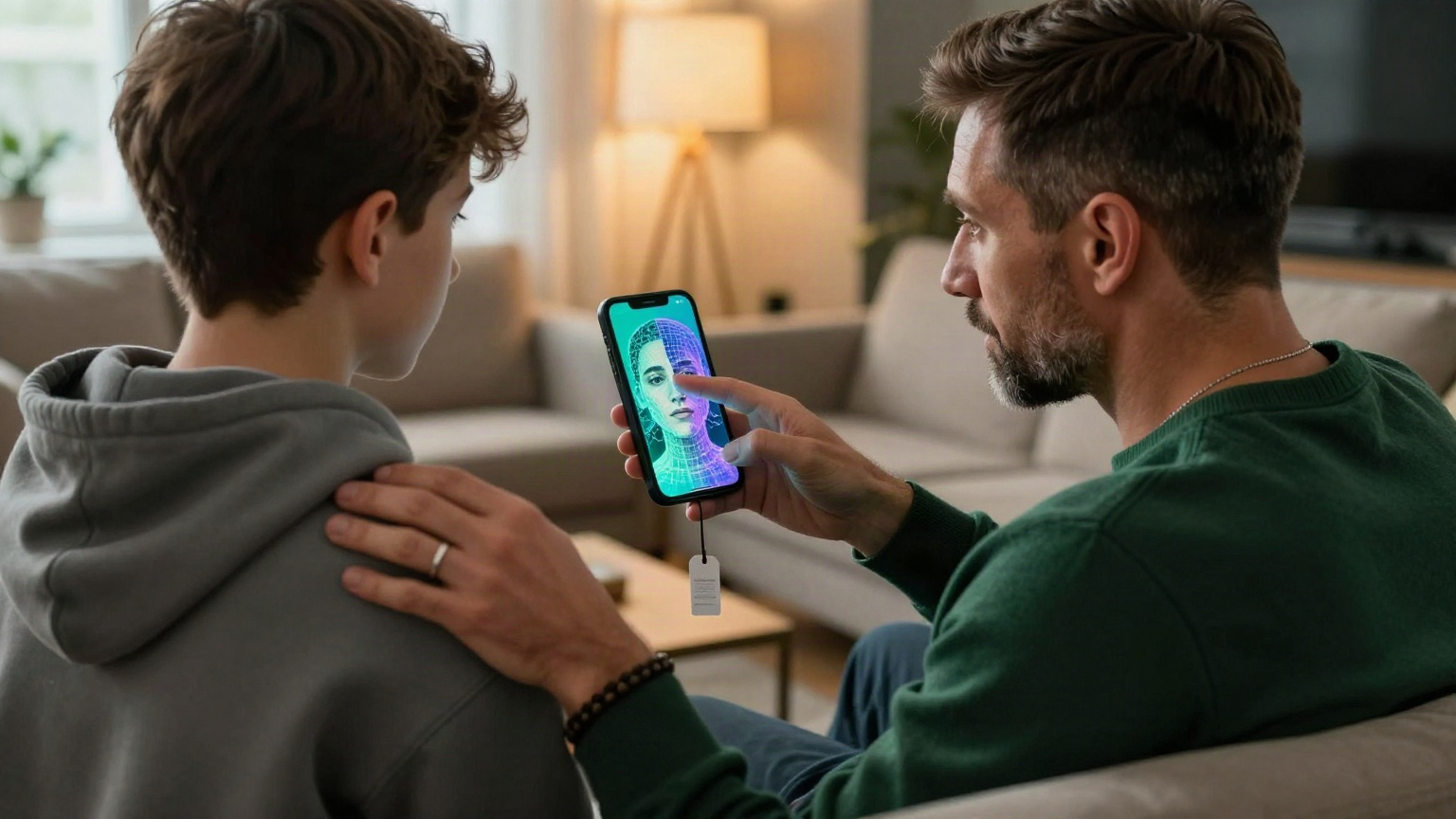
Given these constraints, the most viable remedy operates at the social and educational level, supplementing rather than replacing technical safeguards. Adults must reframe the conversation from blanket prohibitions—which often drive the behaviour further underground—to discussions about the mechanics and ethics of AI generation. If a teenager understands how an AI porn generator relies on massive datasets likely built from non-consensual imagery, the ethical weight of using such a tool becomes concrete rather than abstract. Teaching adolescents to recognise the pipeline from innocent editing to harmful generation equips them to self-regulate at the point of escalation.
Furthermore, fostering critical analysis of filtered media helps dismantle the normalisation of digital distortion. When teenagers can articulate why a filter is unrealistic, its power to seed body dissatisfaction diminishes. Schools and caregivers should focus on verifying digital media, teaching reverse image search techniques and the artefacts typical of AI generation, thereby shifting the teenager from a passive consumer of edits to an active, sceptical analyst.
Disrupting the Continuum
The pipeline from a skin-smoothing filter to an explicit AI generator is paved by normalised distortion and frictionless access. Counteracting this requires not just restricting the endpoint, but disrupting the mindset that treats all digital alteration as equally harmless. The critical intervention point is not the AI porn generator itself, but the moment a teenager begins to accept that their unmodified selfA unmodified self is insufficient. By addressing the symptoms of body dysmorphia, verifying the actual capabilities and ethical deficits of generative tools, and implementing scalable educational remedies, it becomes possible to sever the connection between aesthetic editing and explicit generation. The goal is not to eliminate digital creativity, but to ensure it is exercised with an intact understanding of consent, reality, and consequence.